Feature
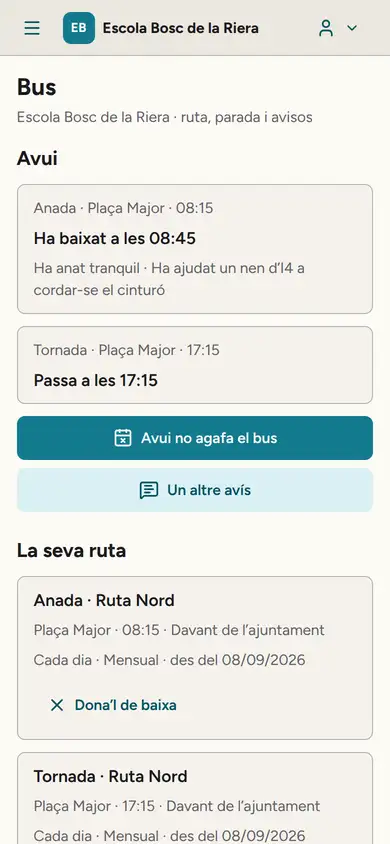
The bus escort marks “Got off” at the stop, and the parent sees it on their phone.
Reviewed on
The short answer
Auladia runs school transport: outward and return routes with their stops and escorts, which pupil uses which stop on which days, and the escort’s trip in the app, marking “Got on” and “Got off” even with no signal.
Parents see the status of their child’s trip when they open the app, and the school office sees every route for the day and anyone who got on the bus but is marked absent in class. It is an add-on to any plan that already has families, billing and attendance.
A bus trip, stop by stop
At Escola Bosc de la Riera, the made-up school in the screenshots, 32 pupils use the bus, on 2 routes.
- Anna Ribera, the school secretary, sets up each route: outward or return, stops with time and address, the vehicle or operator, capacity and the escort. Also the calendar: days with no bus and timetable changes.
- Each pupil has a route, a stop and set days, on a monthly or single-day option. Parents sign them up in the app before the deadline, or book a single day.
- If the child is not taking the bus one day, or someone else on their pick-up list is collecting them, the family says so in the app and the escort sees it on the row.
- Jordi Esteve, the bus escort, opens the trip on his phone: the list by stop, with the family’s notice and each child’s health flag. At each stop he marks “Got on” or “Not here” and, at the drop-off stop, “Got off”. With no signal, the row says “Waiting to send” and the mark goes out on its own when the network returns.
- On the return trip, the row shows “Goes home alone” or who may collect the child, and in red who may not because of a court restriction, by name only.
- At the end, Jordi closes the trip. If anyone is still on board, the app will not let him.
Who sees each piece of bus data
| Who | What they see |
|---|---|
| The escort | Only the routes they escort, and only today: names, class, stop, the family’s notice, allergens, diet and auto-injector, and who may collect the child. |
| Parents | Their child’s route, stop and times, the status of today’s trip and the escort’s note. |
| School office and leadership | Every route, any day: expected, notified, on, off, still on board, and the check against attendance. |
Every time the escort views a pupil’s health flag it is logged, and the family can see it in their access log. The GDPR requires each person to process only the data they need (Art. 5(1)(c)) and gives health data special protection (Art. 9). How it works with separated parents is covered in the guide on separated parents.
What the rules say about the bus escort (Spain and Catalonia)
- Royal Decree 443/2001, Art. 8, requires an adult on board, besides the driver, to look after the children during the trip and while getting on and off, among other cases whenever the transport is by coach and at least half the passengers are under twelve. Where the escort is required, the bus cannot run without them, unless not running the trip would put the children at greater risk.
- In Catalonia, Decree 161/1996, in force, regulates the free school transport service for compulsory-education pupils who attend school outside their own town. On that service an escort is required on every vehicle (Art. 6.1) and must check pupils on and off at each stop against the list the school provides, and make sure each pupil is handed to a family member or designated person (Art. 6.4).
Auladia does not replace the escort: it is the list in their hand, with a record of every mark.
What the school office sees for the day
On a computer, the office sees each route with its time, escort and the day’s counts, and the summary counts children, not trips. In the office screenshot on the day of the screenshots, all 32 bus pupils had got on and the screen says everything adds up (the interface is in Catalan and Spanish).
The check against the class register is listed by severity: got on the morning bus but marked absent in class, did not get off, missing with no notice, missing but in class, no mark.
If a route is running late, the office records the delay and the route’s families get a single notice. In an incident, school leadership can send an emergency message to every family on the route.
Frequently asked questions
Can the escort mark who gets on with no signal?
Yes. The mark is saved on the escort’s phone and sent automatically when the network returns. If an older mark arrives after a newer one, it does not overwrite it.
Do parents get a notification every time their child gets on or off?
No. They see it when they open the app, with the escort’s note if there is one. Only a route delay, once per trip, and emergencies trigger a notification.
What if grandad is collecting today at the stop?
The family says in the app that someone else on their pick-up list is collecting. Someone not on the list, or excluded by a court restriction, cannot be chosen.
Can the escort see pupils’ health data?
Only allergens, diet and whether the child carries an auto-injector, for pupils on today’s route and within the family’s consents. Nothing else from the record.
How is the bus billed?
On the fee statement, a month in arrears: the monthly option as one charge per month; single days each at the price when booked. No day is charged twice.
What Auladia does for the school bus
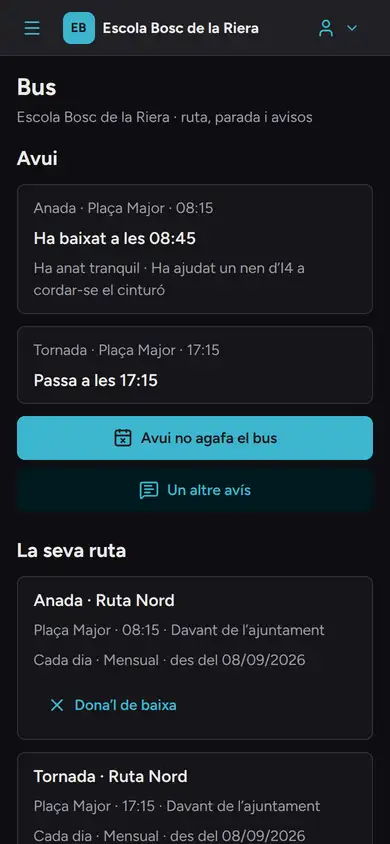
The transport module is an add-on: it is in no starting plan and can be added to any plan that already has families, billing and attendance, because it uses the pick-up list, the fee statement and the day’s attendance. The screenshot shows Pol’s bus on his mother’s phone: today’s outward trip, marked as got off with the escort’s note that he was calm, and the return time.
The escort’s trip works offline, just like taking the class register with no signal.
Auladia does not track the bus by GPS: the status comes from the escort’s marks. The app for iPhone, iPad and Android is in pilot, and the interface is in Catalan and Spanish; see what it does not do yet in Coming next.
Modules, plans and add-onsSources
The rules and official documents this page cites.
- Royal Decree 443/2001 on safety conditions in school and child transport, Articles 1 and 8 (Spanish) BOE (Spanish Official Gazette)
- Catalan Decree 161/1996 regulating the school transport service in compulsory education, Articles 1 and 6 (Catalan) Legal Portal of Catalonia
- Regulation (EU) 2016/679, General Data Protection Regulation, Articles 5 and 9 EUR-Lex
This page describes what Auladia does on the review date; what it does not do yet is on Coming next. Published on .
Want to see it on screen?
In the demo we show you how Auladia handles it with a made-up school’s data, and what it does not do yet.
Request a demo