Feature
The family reports the absence before attendance is taken, and the office chases nobody.
Reviewed on
The short answer
Auladia covers attendance from end to end: the teacher takes attendance on a phone or tablet, even with no signal; the family reports an absence in the app and excuses it with a photo of the note; and the school office or the homeroom teacher approves the note with one tap.
Unexcused absences are counted for each student, and when they cross the school’s threshold the student appears in the absenteeism tray of the homeroom teacher and school leadership, which is where the Catalan Department of Education’s absenteeism protocol starts. The app and the management screens are in Catalan, Spanish and English.
How an attendance day works at school
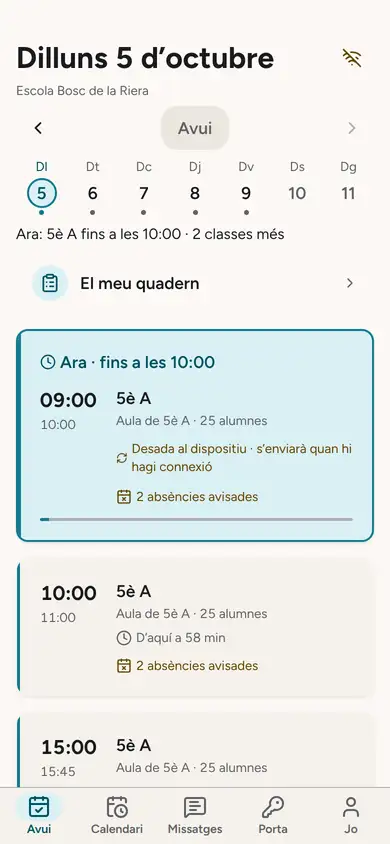
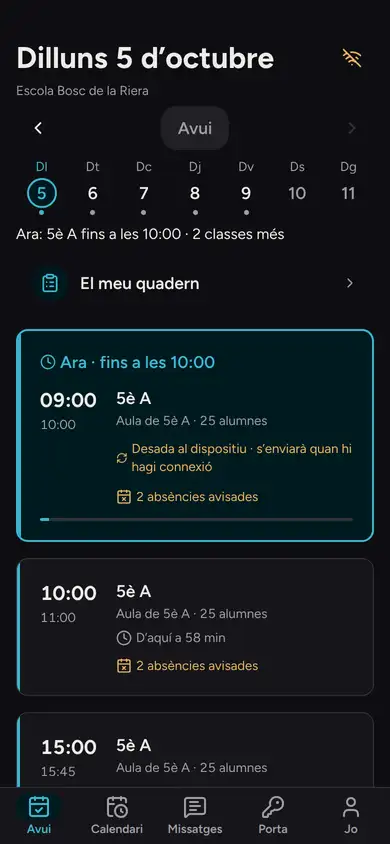
- Before the lesson starts, Laia Serrat, homeroom teacher of Grade 5 A, opens the class in the app. Two absences already show as reported by the families, with the reason: nobody needs to call.
- She marks everyone present and adjusts the exceptions: absent or late. If the classroom has no signal, the attendance list is stored encrypted on the device and sent on its own when the network returns; the guide to taking attendance offline explains how.
- Pol’s mother, Rosa Sánchez, reports in the app that her son will be late. Laia sees it on Pol’s row.
- A family that had not reported an absence picks it in the app, gives the reason and takes a photo of the doctor’s note.
- Anna Ribera, the school secretary, has the note in her tray, oldest pending first. She approves it with one tap, or rejects it and writes the reason.
Approving a note marks the absences for that period as excused. If the student had an absenteeism alert and drops below the threshold, the alert clears itself.
The note arrives with the photo, without the home location
The family excuses absences from their phone or the web portal. The app lists the child’s absences and late arrivals from the last 14 days that have no note yet; they pick one or more, give the reason and, if they wish, attach a photo of the note; on the web portal they can also attach a PDF.
- The photo is redrawn on the phone before it is sent, so it loses its metadata, including where it was taken.
- The server checks that the file is what it claims to be and is complete, and runs it through an antivirus before storing it.
- Only the family and whoever approves the note see the reason and the document. A medical report is health data: the AEPD guide for schools says students’ data should only be accessed by those who need it for their job.
- For an absence that has not happened yet, the family sends a notice (illness, medical appointment, school, family or another reason). A late-arrival notice does not excuse the absence if the student never shows up.
When unexcused absences become absenteeism
Catalan Law 14/2010, Art. 52, defines absenteeism as missing class without a note or without an acceptable reason. The Catalan Department of Education’s absenteeism protocol grades it by the share of the month’s lessons missed without an excuse:
| Level | Lessons in the month missed without an excuse |
|---|---|
| Mild (occasional) | Under 5% |
| Moderate | 5% to 25%, both included |
| Severe (regular or chronic) | Over 25% |
| Dropping out | 100% |
- Under the protocol, once a case is detected the school must contact the family; if nothing changes, the principal reports it in writing to the local social services.
- In Auladia, when a student crosses the school’s threshold, they appear in the absenteeism tray with a level: notify the family, notify the homeroom teacher or open a case file. The homeroom teacher can message the family from the same row.
Behavior: the incident, the measure and the family’s say
The Catalan Education Act, Art. 37, requires each school’s rules to list unexcused absence and lateness among conduct contrary to the school’s rules, and Decree 102/2010, Arts. 24 and 25, requires the school to hear the student and the family before sanctioning seriously harmful conduct, with five school days to see the file and five more to respond in writing.
- The teacher logs the incident in the app, offline too: students involved, when, where and what happened. They do not grade it.
- The head of studies or the principal decides how serious it is and, if needed, applies a measure with two texts: the one the family will read and an internal note.
- The family receives a notice with a read receipt, reads the measure in the portal and can give their side once, as a written response.
- A measure for seriously harmful conduct stays pending a hearing and cannot be closed until the hearing has been recorded.
Who sees what
| Who | What they see and can do |
|---|---|
| Teacher | Attendance for their classes and the family’s notice with the reason. Logs incidents. Does not see the note’s document. |
| Homeroom teacher | Also approves notes for their class and follows its absenteeism alerts. |
| School office | Approves notes for the whole school. Does not follow the absenteeism tray. |
| Head of studies and principal | Notes, absenteeism alerts and behavior for the whole school; they grade incidents and apply measures. |
| Front desk | Neither notes nor absenteeism. |
| Family | Only their own children: they report, excuse, read measures and respond to them. |
Frequently asked questions
Can teachers take attendance with no signal?
Yes. The attendance list is stored encrypted on the device, the screen says whether it is saved, sending or done, and it is sent on its own when the network returns. The guide to taking attendance offline has the details.
Does the family have to call the school when their child is out?
No. They report it in the app, choosing the day or days and the reason, and the teacher sees it on the attendance list before starting. They can also report that the child will be late, and then choose which lesson.
Who sees the medical reason on a note?
The family and whoever approves it: the school office, the homeroom teacher, the head of studies or the principal. Teachers who are not homeroom teachers and the front desk do not.
When does an absence count as absenteeism?
Under the Department’s protocol, missing 5% of the month’s lessons without an excuse is moderate absenteeism, and over 25% is severe. Your school’s absenteeism plan sets out what happens next.
Does the photo of the note carry our home location?
No. The app redraws the photo before sending it and strips its metadata, and the server rejects any file that still has it.
Can the family respond to a behavior measure?
Yes. They read it in the portal, confirm they have received it and can submit a written response. For seriously harmful conduct, the measure cannot be closed without the hearing.
What Auladia does
On the teacher’s phone, the attendance list with each family’s notice next to the student’s name, even with no signal. In the family app, the absence or late-arrival notice and the note with its photo. In the school office, the notes tray with search, the document one click away and rejection with a reason. For the homeroom teacher and school leadership, the absenteeism and behavior trays, with the hearing and the family’s response.
Everyone sees only what their role needs, and a note’s document opens with a permission that lasts a few minutes and is logged. The security page explains how children’s data is protected.
The app for iPhone, iPad and Android is in pilot, and it is in Catalan, Spanish and English. Absenteeism thresholds cannot yet be changed from the school’s screens, the absenteeism notice is not sent to the family automatically, and the absenteeism case file (actions and referral) and the full disciplinary file for serious conduct are still kept outside Auladia.
The school office’s day with AuladiaSources
The rules and official documents this page cites.
- Community protocol for preventing, detecting and acting on absenteeism (Catalan) Catalan Department of Education
- Law 14/2010 on the rights and opportunities of children and adolescents, article 52 (Spanish) BOE
- Law 12/2009 on education (Catalonia), article 37 (Spanish) BOE
- Decree 102/2010 on school autonomy, articles 24 and 25 (Catalan) Portal Jurídic de Catalunya
- Guide for schools (Spanish) Spanish Data Protection Agency (AEPD)
This page describes what Auladia does on the review date; what it does not do yet is on Coming next. Published on .
Want to see it on screen?
In the demo we show you how Auladia handles it with a made-up school’s data, and what it does not do yet.
Request a demo