Feature
The monthly receipts are prepared in one click, and a second person approves the batch.
Reviewed on
The short answer
Each month Auladia prepares the school’s batch of receipts, with fees, discounts, scholarships and the split between parents, and produces the SEPA direct debit file in the bank’s format.
Before the debit it prepares each family’s pre-notification, the batch is approved by someone other than the person who generated it and, when the bank returns a debit, the return is recorded with its reason so the family can pay another way. The interface is in Catalan, Spanish and English.
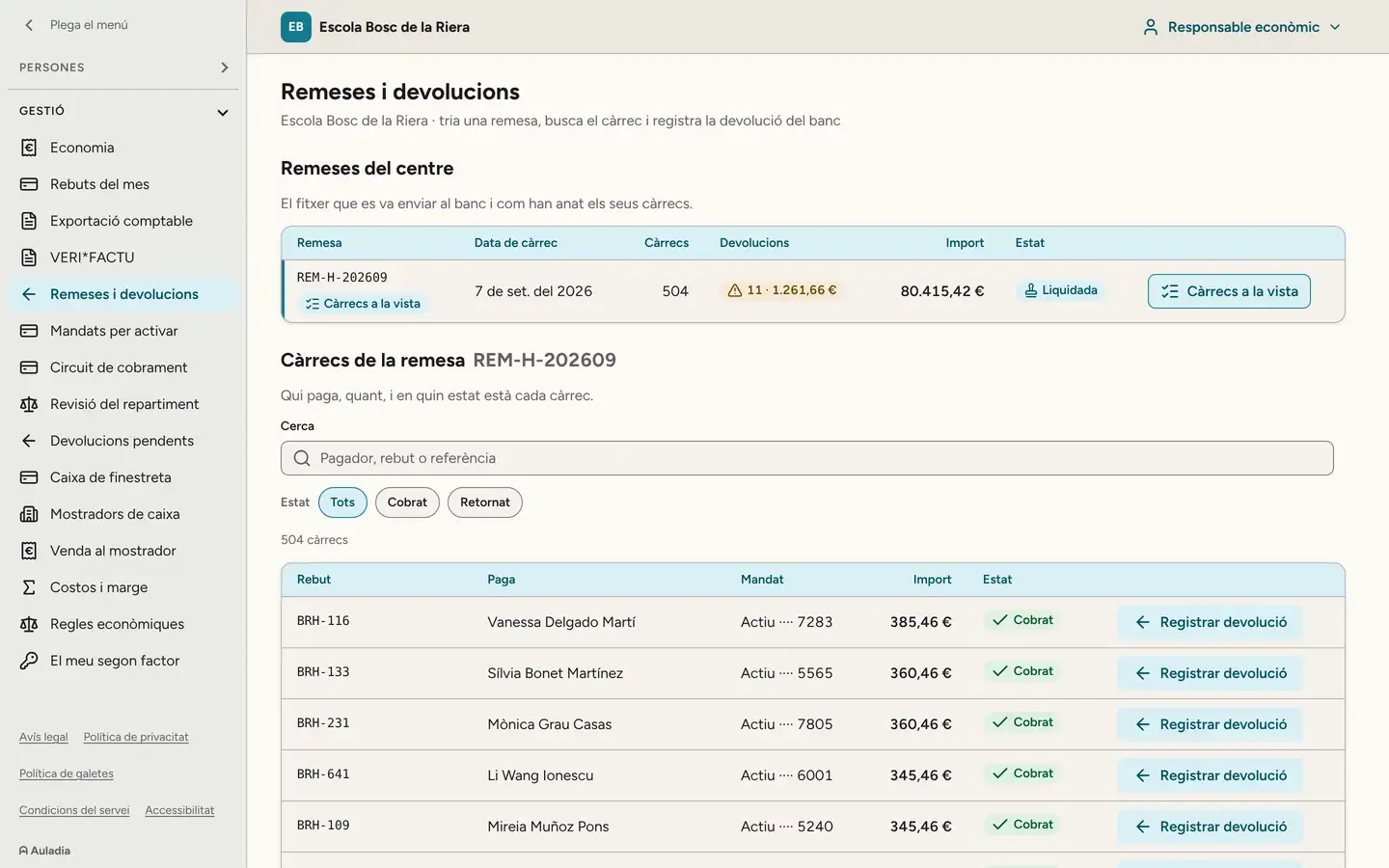
The billing month, step by step
- Auladia prepares the month’s batch from what each student is signed up for (fees, school lunch, after-school activities, bus) and applies discounts and scholarships.
- If the parents split the cost, each share is worked out to the cent so that both add up exactly to the fee. On a 50 % split, the odd cent goes to whoever is listed as the main payer.
- The system prepares each family’s pre-notification with the amount and the debit date, with the notice period the school has agreed: 14 days if no other has been agreed. The family sees the debit date on each receipt; the email notice will go out once Auladia’s email is live.
- The finance manager generates the batch: the SEPA file in the bank’s format, which is uploaded to the school’s online banking. Mandates blocked by an earlier return are left out.
- The principal, Montserrat Vidal, reviews and approves it with two-step verification. The principal’s role cannot generate batches, and the system does not let the person who generated a batch approve it.
- When you upload the bank’s returns file, each returned debit appears under the batch’s “Returned” figure with its reason, and the family sees the receipt as returned by the bank.
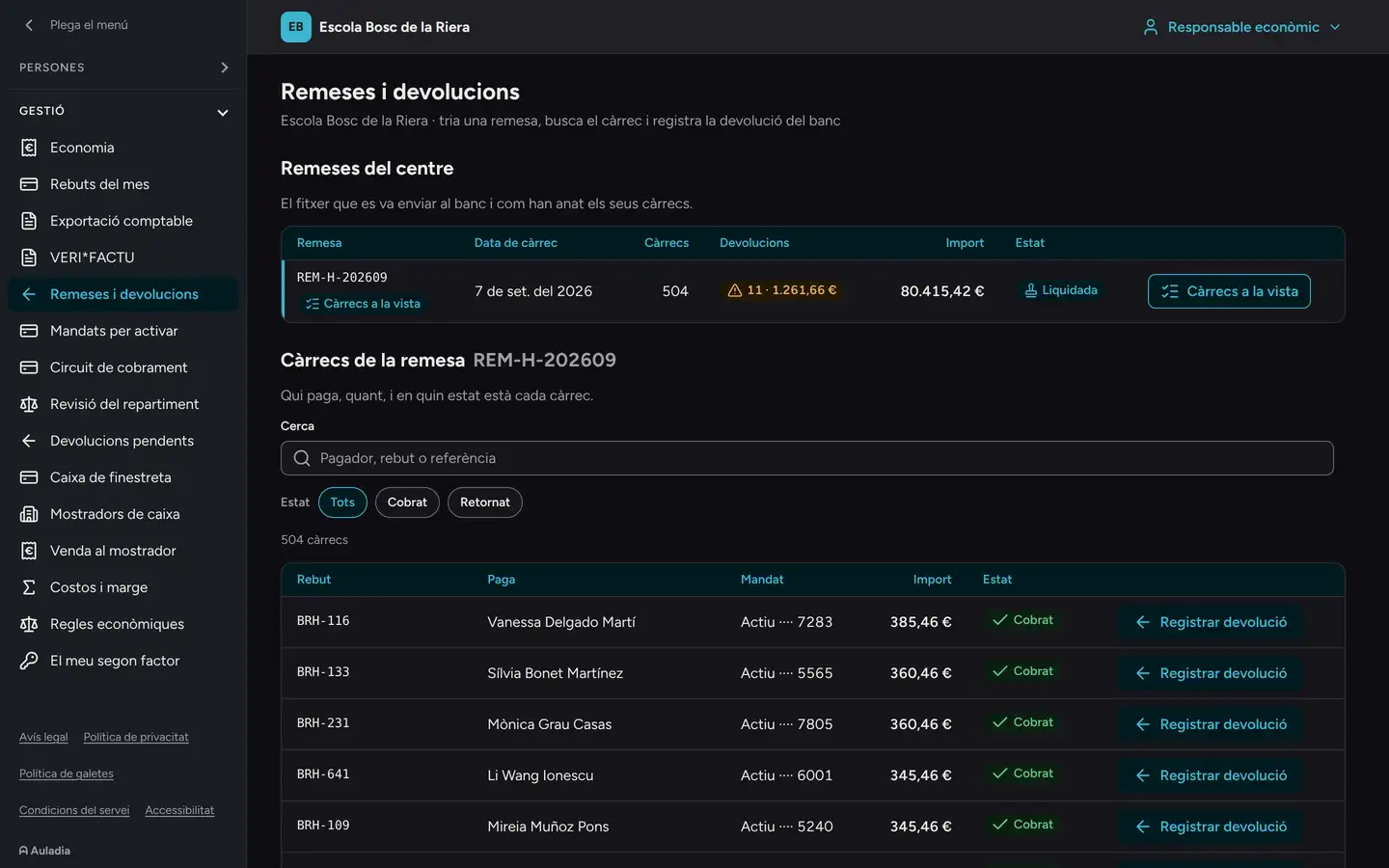
The screen above is the made-up school’s September batch: settled, with the returns counted and, debit by debit, the receipt, who pays and under which mandate. What each return code means and what to do about it is in the SEPA direct debit guide.
Paper mandates still count
A SEPA direct debit needs a mandate signed by the account holder, with a unique reference and the creditor identifier, as Regulation (EU) 260/2012 requires. If the school already holds them on paper, they are imported with the rest of the data and, once the school states where it keeps the originals, they are valid from the first month: no scanning needed.
A new family registers its account from the family portal, with two-step verification, but the mandate stays as a draft until they hand the signed direct debit form in to the school. A web form does not capture the signature the bank requires, and the bank returns an unsigned mandate.
Who sees each receipt
- Pol’s mother, Rosa Sánchez, sees one receipt in her name on her home screen: her half. She does not see the father’s, Marc Rovira, and he does not see hers. Each receives their own invoice or receipt.
- A student aged 14 to 17 with their own account sees nothing of the family’s finances: not the fee, the discounts or the split. At 18, they see the receipts for their own education.
- If a court order removes a parent’s parental authority and that parent paid a share, they still see and pay their own receipts, and nothing else.
- Approving a batch for the bank and changing a mandate require two-step verification.
The cash desk and the cash limit
At the front desk, Anna Ribera, the school secretary, takes cash for receipts and prints them right away. Once the school issues invoices with VERI*FACTU, she will also record sales of materials paid in cash, by card or with Bizum, with their invoice.
Spanish Law 7/2012, art. 7 bans cash payments of 1,000 euros or more when one party is acting as a business or professional, and adds up all the payments a single service has been split into. Auladia applies the limit automatically, also when both parents pay separately for the same service.
Invoice or receipt, depending on the school’s VAT
School education, childcare and school lunch provided by the authorized school itself are VAT-exempt in Spain (VAT Law, art. 20.1.9), and those transactions do not require an invoice (RD 1619/2012, art. 3). That is why Auladia supports both: invoice or receipt, as your adviser tells you. Invoice mode, and with it sales of materials with their VAT, works with VERI*FACTU and will open once we have signed the statement of compliance; until then, Auladia issues receipts.
VERI*FACTU is included in the billing module at no extra cost: the chained record, the tax QR code and submission to the Spanish Tax Agency. Each school decides whether to switch it on voluntarily before it becomes mandatory, and when it does become mandatory nothing has to change. Before any school switches it on, we will sign the statement of compliance for the system and test submission with the Agency. Who has to adapt and when is in the VERI*FACTU guide.
Frequently asked questions
Can separated parents each pay their own share of school lunch?
Yes. Each parent has their own mandate and receipt, the share is worked out to the cent and the odd cent goes to the main payer. If one returns their share, the other’s stays paid.
Who can send the batch to the bank?
The finance manager generates it and the principal approves it, with two-step verification. The system does not let the same person generate and approve it.
Do families have to sign all their mandates again when we move to Auladia?
No. Paper mandates are imported and are valid from the first month if the school states where it keeps the originals. Only new families need to hand in a signed direct debit form.
Can a family pay a returned receipt by card from the app?
Not yet: online card and Bizum payment is being prepared. Today, a receipt returned for insufficient funds is presented to the bank again and cannot be paid at the front desk meanwhile; other returned receipts are paid at the front desk or by bank transfer.
A family wants to pay the term in cash. What is the limit?
If the amount reaches 1,000 euros, it cannot be paid in cash, counting all the payments for the same service together. Auladia’s cash desk will not record it.
Does VERI*FACTU cost extra?
No. It is included in the billing module at no extra cost. A school can switch it on voluntarily before it becomes mandatory, and when it does become mandatory nothing has to change.
What Auladia does with fees
It prepares the batch of receipts with fees, discounts, scholarships and the split to the cent, each family’s pre-notification and the direct debit file in the bank’s format, approved by someone other than the person who generates it. It records returns with their reason, imports paper mandates and runs the cash desk with the cash limit applied automatically.
It issues receipts, and invoices once invoice mode opens with VERI*FACTU. VERI*FACTU is included in the billing module at no extra cost, and each school can switch it on voluntarily before it becomes mandatory. Before any school does, we will sign the statement of compliance and test submission with the Spanish Tax Agency. The screens are in Catalan, Spanish and English.
Online payment by card and Bizum (enrollment, tickets and returned receipts) is being prepared: see its status on Coming next.
The school office’s day with AuladiaSources
The rules and official documents this page cites.
- Regulation (EU) No 260/2012 establishing technical and business requirements for credit transfers and direct debits in euro EUR-Lex
- Law 7/2012, article 7: limits on cash payments (Spanish) BOE
- Royal Decree 1619/2012, invoicing obligations, article 3 (Spanish) BOE
- Law 37/1992 on VAT, article 20.1.9: education exemption (Spanish) BOE
- Royal Decree-law 15/2025, first final provision: new deadlines (Spanish) BOE
This page describes what Auladia does on the review date; what it does not do yet is on Coming next. Published on .
Want to see it on screen?
In the demo we show you how Auladia handles it with a made-up school’s data, and what it does not do yet.
Request a demo