Feature
The teacher sets the level in the gradebook, and the family sees the same on the report card.
Reviewed on
The short answer
Auladia handles assessment from start to finish: the teacher grades in the gradebook with the achievement scale used in Catalan basic education (NA, AS, AN and AE), decides each subject’s grade for the term, the homeroom teacher adds a comment and the family and the student download the report card as a PDF.
The family, the student and the report card all see exactly the grade the teacher gave, and a published grade can only be corrected with a stated reason, which stays in its history. The app and the management screens are in Catalan, Spanish and English.
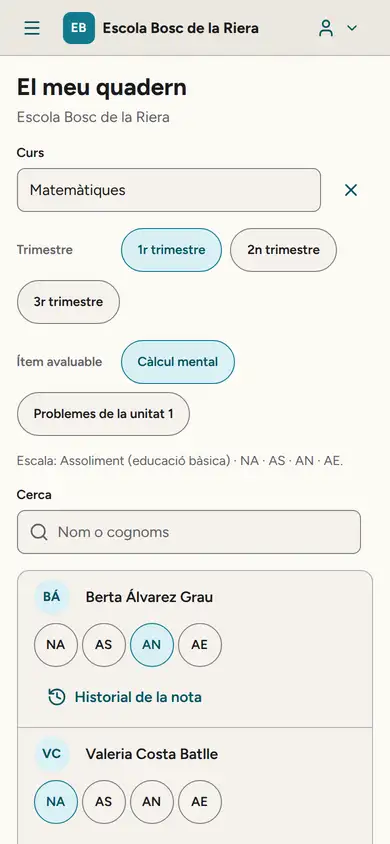
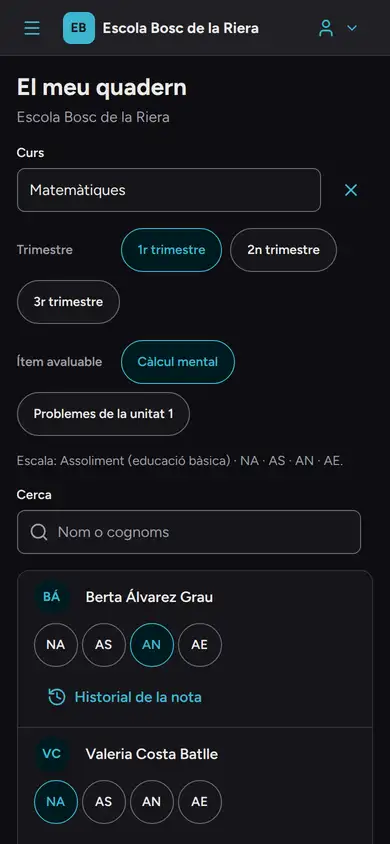
The teacher’s gradebook with the achievement scale
Catalan Decree 175/2022 requires every teacher to keep a record for systematically noting observations of students’ learning (Art. 23.8), and sets the scale for reporting results in basic education (Art. 29.2):
| Code | Meaning |
|---|---|
| NA | Not achieved |
| AS | Satisfactory achievement |
| AN | Notable achievement |
| AE | Excellent achievement |
- Laia Serrat, homeroom teacher of Grade 5 A, opens the first-term Math gradebook on her phone, picks the item “Mental arithmetic” and taps each student’s level: one button per level.
- If the network drops while the gradebook is open, each item’s level is saved on the device and sent when the connection returns. The gradebook opens with a connection.
- The decree says these are the indicators families and students must receive, and Auladia uses them unchanged in the gradebook, the report card and the PDF.
The subject grade and the homeroom teacher’s comment
- At the end of the term, the teacher opens the subject grade, sees the suggestion drawn from the gradebook and decides each student’s grade, on the web or in the app.
- The homeroom teacher sees in the gradebook how many report card comments are still missing and writes them student by student. Only the homeroom teacher can write them; other teachers of the class do not see them, and the family reads them on the published report card.
- The principal or the head of studies issues the class’s report cards. An issued report card is locked: if it has to change, it is reopened and issued again with the reason.
The report card for families, in the school’s own format
Decree 175/2022, Art. 24, asks each school for its own qualitative report after every assessment meeting, which the homeroom teacher passes on to each student and their family, and requires the end-of-year report to cover every subject. The Catalan Education Act, Art. 25, gives families the right to information on their children’s progress.
- School leadership chooses what each stage’s report card shows: the grade for each subject, the cross-curricular competences, the homeroom teacher’s comment and each subject’s comment, with the school’s header and footer.
- The family and the student download it as a PDF from the app or the portal. If the parents live apart, each reads it through their own access.
- The end-of-year report card cannot be published while any subject is missing its grade.
- The report card never includes psychological assessment or health information.
Correcting a published grade
A published grade can be corrected, but the teacher must give the reason. The grade’s history keeps the old value, the new one, who changed it and why, and is never deleted.
If a family disagrees, the route is a grade appeal, not the data protection right to rectification: the AEPD guide for schools notes that this right does not apply to grades. Today the family files it with the school, and the school records and resolves it in Auladia; if the grade changes, the school corrects it with the reason.
Official records and the academic transcript: what Decree 175/2022 requires and what Auladia covers today are in the guide to assessment records, and their status on Coming next.
Students aged 14 and 18
Spain’s data protection act, Art. 7, lets a minor consent to the processing of their data from the age of 14. So from 14 the school office can invite a student to have their own account; below that age, Auladia does not send the invitation.
- With their account, the student sees their schedule, their grades and their report card. While they are under 18, they see nothing of the family’s finances: not the fee, the discounts or how the parents split it.
- At 18, the student decides what their parents can keep seeing. Whoever pays keeps seeing their own receipts.
- The AEPD accepts that parents who pay for an adult child’s education may ask the school for their grades, as they have a legitimate interest. For children’s data at school, see the guide on children’s data.
Frequently asked questions
What grading scale do Catalan primary schools use?
Not achieved (NA), satisfactory achievement (AS), notable achievement (AN) and excellent achievement (AE), under Article 29.2 of Decree 175/2022. Secondary schools (ESO) use the same scale.
Can families download the report card as a PDF?
Yes, from the app and the portal, each parent through their own access. The PDF follows the report card format the school has chosen.
Can a grade be changed after families have seen it?
Yes, with a mandatory reason that stays in the grade’s history. If the report card had already been issued, it is reopened and issued again, also with the reason.
Can a family appeal a grade from the app?
Not yet. Today the family files the appeal with the school, and the school records and resolves it in Auladia; if the grade changes, the school corrects it with the reason.
Can a 14-year-old student see their own grades?
Yes, if the school gives them their own account: they see their schedule, grades and report card, and nothing of the family’s finances.
Do parents of an 18-year-old still see the grades?
The student decides. Whoever pays keeps seeing the receipts, and the AEPD accepts that parents who pay for their education may ask the school for the grades.
What Auladia does
The teacher’s gradebook on phone and web, with the achievement scale and one button per level. The subject grade with the gradebook’s suggestion next to it. The homeroom teacher’s comment on the report card. The report card in the school’s own format, as a PDF for the family and the student. Corrections with a reason and a history for every grade.
Teachers see only the students in their classes, and each family only their own children. The security page explains how children’s data is protected.
The app for iPhone, iPad and Android is in pilot, and it is in Catalan, Spanish and English. Families cannot yet file a grade appeal from the portal: they file it with the school, which records it.
A teacher’s day with AuladiaSources
The rules and official documents this page cites.
- Decree 175/2022 on basic education, articles 23, 24 and 29.2 (Catalan) Portal Jurídic de Catalunya
- Law 12/2009 on education (Catalonia), article 25 (Spanish) BOE
- Organic Law 3/2018 on data protection and digital rights, article 7 (Spanish) BOE
- Guide for schools: grades (Spanish) Spanish Data Protection Agency (AEPD)
This page describes what Auladia does on the review date; what it does not do yet is on Coming next. Published on .
Want to see it on screen?
In the demo we show you how Auladia handles it with a made-up school’s data, and what it does not do yet.
Request a demo