Feature
The lunch supervisor knows what each child cannot eat without opening a health record.
Reviewed on
The short answer
Auladia runs the school’s lunch service and breakfast club: the menu with the allergens in each dish, the options and sittings, the supervisor’s register on a phone, and the charge on the fee statement a month in arrears.
In the register, next to each name, the supervisor sees only allergies, diet and whether the child carries an auto-injector: no diagnosis and no other health data. Parents see the menu with the dishes containing one of their child’s allergens flagged.
A school lunch, step by step
At Escola Bosc de la Riera, the made-up school in the screenshots, 345 pupils have lunch in 3 sittings, with 14 lunch supervisors.
- Anna Ribera, the school secretary, publishes the week’s menu: starter, main course and dessert for each day, with each dish’s allergens ticked. She can copy the previous week or upload the kitchen’s PDF, and prepare a special-diet version (“Gluten-free”, “No pork”).
- Parents choose one of the options the school offers within the deadline, or buy a ticket for a single day. If their child will not be staying, they report it from their phone before the service’s cut-off time, which the school sets.
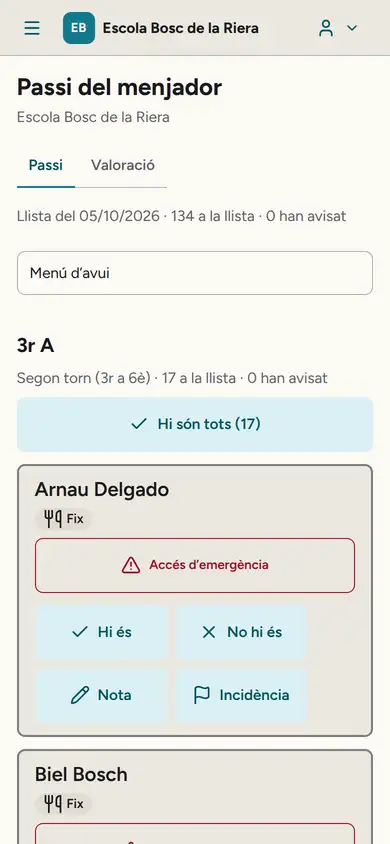
- At lunchtime, Núria Pallarès, a lunch supervisor, opens the register on her phone: she only sees the classes in her own sittings, class by class. She marks “Present” or “Absent”, or “All present” for a whole class at once.
- Next to each name is the food alert: allergens, diet and “Carries auto-injector”, with an icon and a word. Pupils whose families have reported an absence are listed separately.
- If needed, Núria leaves a quick note for the day (“Ate little”) that parents read in the app, or logs an incident.
- At the end of the month, the fee statement charges the days served in the previous month.
Who sees each piece of lunch data
| Who | What they see | What they do not see |
|---|---|---|
| The supervisor | Today’s register for their sittings, with the food alert for each pupil eating | The full health record, other sittings, fee statements |
| Parents | The menu with their child’s allergens flagged, the enrolment, the daily notes and who has viewed their child’s alert | Other pupils’ data |
| School office and leadership | The day’s register by sitting and class, and the enrolments | Anything their role does not need |
Every time the supervisor views a pupil’s food alert it is logged, and the family can see it in their access log. Parents fill in the health record themselves; how this data is protected is covered in the guide on children’s data at school.
What the rules on school lunches say (Spain)
- Royal Decree 315/2025, which applies to state, state-funded and private schools (Art. 2), requires special menus for pupils with a medically diagnosed allergy or intolerance, backed by a certificate (Art. 10.1), and requires schools to give families the name of each dish with its list of allergens (Art. 11.3). It came into force twelve months after publication in the BOE.
- Law 17/2011, Art. 40, requires schools to give families the monthly menu plan as clearly and in as much detail as possible, and to guarantee alternative menus for coeliac pupils. If a school cannot cook the special menu, it must provide the means to chill and heat food brought from home.
- Regulation (EU) No 1169/2011 sets the 14 allergens that must be declared (Annex II) and requires that information for non-prepacked food too, such as school lunches (Art. 44).
The maximum price of school lunch in Catalonia
The Catalan Department of Education sets the maximum lunch price each year for the schools it owns. For 2026-2027, under Resolution EDF/483/2026 (DOGC No 9613, 26 February 2026), it is €7.83 per pupil per day, VAT included, where the midday break lasts up to two and a half hours, and €7.41 where it lasts up to two hours. Occasional diners can be charged up to 10% more: €8.61 and €8.15 at most.
The price covers the meal and supervision during the service and the time before and after it. This cap applies to the Department’s own state schools (Department page).
What Auladia’s lunch module does not do
- It does not run the kitchen: no recipe costing, stock or supplier orders. The school writes or uploads the menu.
- The food record holds no diagnosis: just allergens, diet and auto-injector, and medication, kept apart, is visible only to staff with health permissions.
- Incidents and messages to parents from the register need a connection; the register and the daily note do not.
Frequently asked questions
Can the lunch supervisor see the allergy diagnosis?
No. They see allergens, diet and whether the child carries an auto-injector, only for pupils in their sittings and only on the day they eat. Every view is logged and the family can see it.
Can the lunch register be taken with no signal?
Yes. In the app, “Present”, “Absent” and the daily note are saved on the phone, the row says “Waiting to send” and they go out on their own when the network returns. If two marks disagree, the later one wins.
If we say our child is not staying for lunch, are we still charged?
If the family reports a full-day absence before the cut-off time the school sets, that day is not charged. After the cut-off it is, because the meal has already been made.
Does the school have to make a menu for every allergy?
It must offer special menus for pupils with a certified allergy or intolerance (RD 315/2025, Art. 10.1) or, if it cannot, chill and heat food brought from home (Law 17/2011, Art. 40).
How is lunch billed when a family has a council lunch grant?
The grant is assigned to the pupil as a discount paid by the awarding body. The fee statement splits it: the county council pays its share and the family pays the rest.
What about the breakfast club?
It is another service in the same module, with its own register: the supervisor picks the breakfast club register and sees the same food alert.
What Auladia does for school lunch
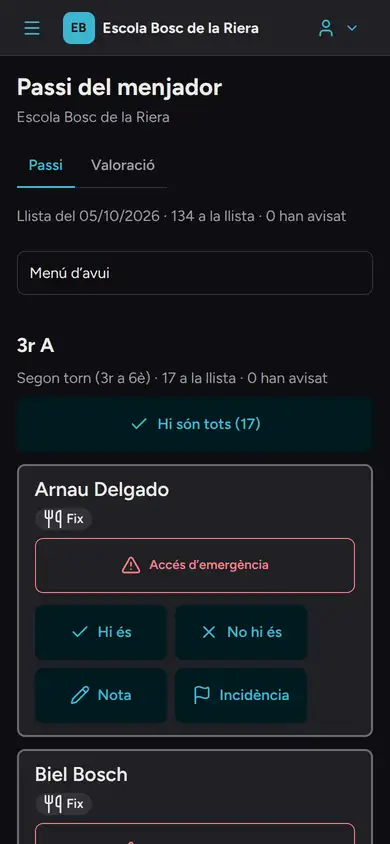
The lunch module covers the lunch service and the breakfast club. The office publishes the menu with allergens per dish, or the PDF, sets up options, sittings and supervisors, and sees the day’s register. The supervisor takes the register on a phone, offline too, with the food alert on each pupil’s row. The screenshot shows the second sitting on the supervisor’s phone; the interface is in Catalan and Spanish.
Parents see this week’s and next week’s menu: Pol’s mother sees the macaroni with tomato flagged “Contains: gluten”, the allergen in her son’s record. The flag is worked out on her phone: the server never matches health data against the menu. Days served go on the following month’s statement at the option or ticket price, and can be paid by SEPA direct debit.
The app for iPhone, iPad and Android is in pilot. Email and SMS notices for people without the app are still being prepared: see Coming next.
Modules and starting plansSources
The rules and official documents this page cites.
- Royal Decree 315/2025 on healthy and sustainable food in schools, Articles 10 and 11 (Spanish) BOE (Spanish Official Gazette)
- Law 17/2011 on food safety and nutrition, Article 40 (Spanish) BOE (Spanish Official Gazette)
- Regulation (EU) No 1169/2011 on the provision of food information to consumers, Articles 9 and 44 and Annex II EUR-Lex
- Resolution EDF/483/2026 setting the maximum price of school lunch for 2026-2027 (Catalan) DOGC (Official Gazette of Catalonia)
- Midday break and school lunch service (Catalan) Catalan Department of Education
This page describes what Auladia does on the review date; what it does not do yet is on Coming next. Published on .
Want to see it on screen?
In the demo we show you how Auladia handles it with a made-up school’s data, and what it does not do yet.
Request a demo